Physical description of a CCD
The CCD is a Silicon plate organized to form a matrix of photosensitive elements in which to accumulate charges (produced by the incident radiation) and read the contents later.
The structure of a CCD basic element can be schematized as seen in fgure below. It is an element called M.O.S. (Metal, Oxide, Silicon). By applying a potential to the electrode, this particular structure allows to create a region where accumulate charges generated by photoelectric effect.
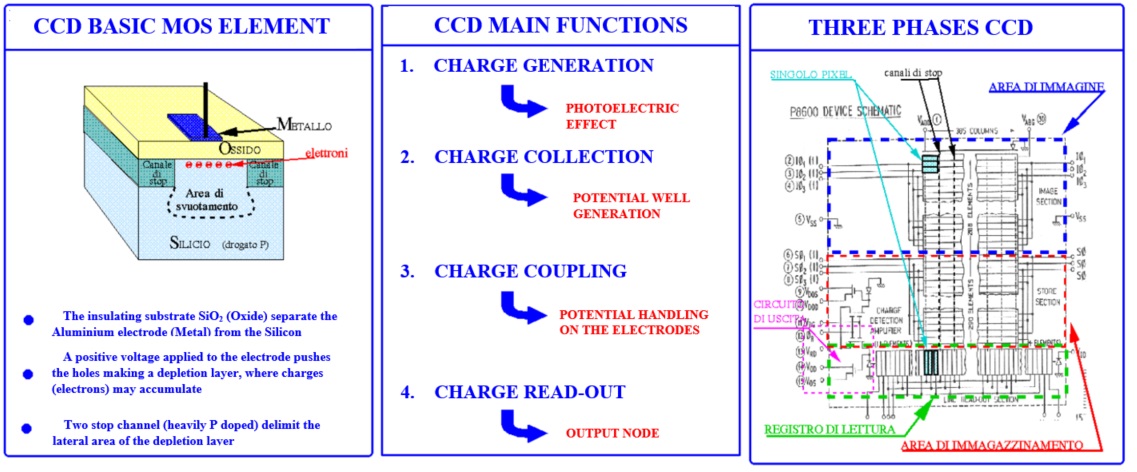
CCD main functions
By schematizing, four fundamental moments can be identified:
- charge generation by photoelectric effect;
- charge collection through potential well generation;
- charge transfer, by varying the electrode potentials appropriately;
- charge extraction by meansof the output circuit.
Typical sructure of a three phase CCD
The figure on the right shows the scheme of a three phase CCD. In this case the pixel is made by 3 MOS elements. Along the vertical columns the separation is obtained with the stop channels (dashed lines).
In this scheme 4 fundamental areas can be identified:
- The image area, sensitive to radiation and in which charges accumulate.
- The storage area, cwhich is covered so as not to be sensitive to radiation, in which the charges generated in the image area are moved to allow a reading free from further radiation contamination (in practice the use of the shutter is eliminated).
- The read-ou register, where an entire row of pixels is transferred, and where the transfer of each pixel to the output circuit begins. Also in this register the pixel is made with 3 MOS elements.
- The output circuit that allows the charge extraction.
Lessons on CCDs and other photon detectors are available in PDF (Italian language)
Characteristics of some CCDs used in astronomical instruments
| e2v 02-06 | Series | |
| e2v 15-11 | Series | |
| e2v 05-20 | Series | |
| e2v 05-30 | Series | |
| e2v 42-80 | (Mounted in a mosaic of 2 x 1on the focal plane of OIG and SARG instruments of the TNG) | |
| LORAL 2K3eb | (Back ill. 2048X2048 pixels S. N. W1-1) | |
| LORAL 2K3eb | (S. N. W1-1(0,0). Used on the DOLORES spectrograph of the TNG) |